Is a video claiming that "all of our food is 3D-printed" or contains bioengineered ingredients to be taken seriously? No, that's not true: A TikTok video sent out a confusing message conflating bioengineered food and 3D-printed foods. Both are real things but they don't mean the same thing. The TikTok creator who made the claims as she reviewed food products made it clear in other videos that her videos are "for entertainment only" and should not be considered good health advice.
The video (archived here) was published on TikTok by @hethskiii on Dec. 1, 2025. It was captioned:
Just go ahead and line us all up and shoot us why don't ya ?!? #bioengineered #3dprinting #fyp #fakefood #food
This is a screenshot of the video:
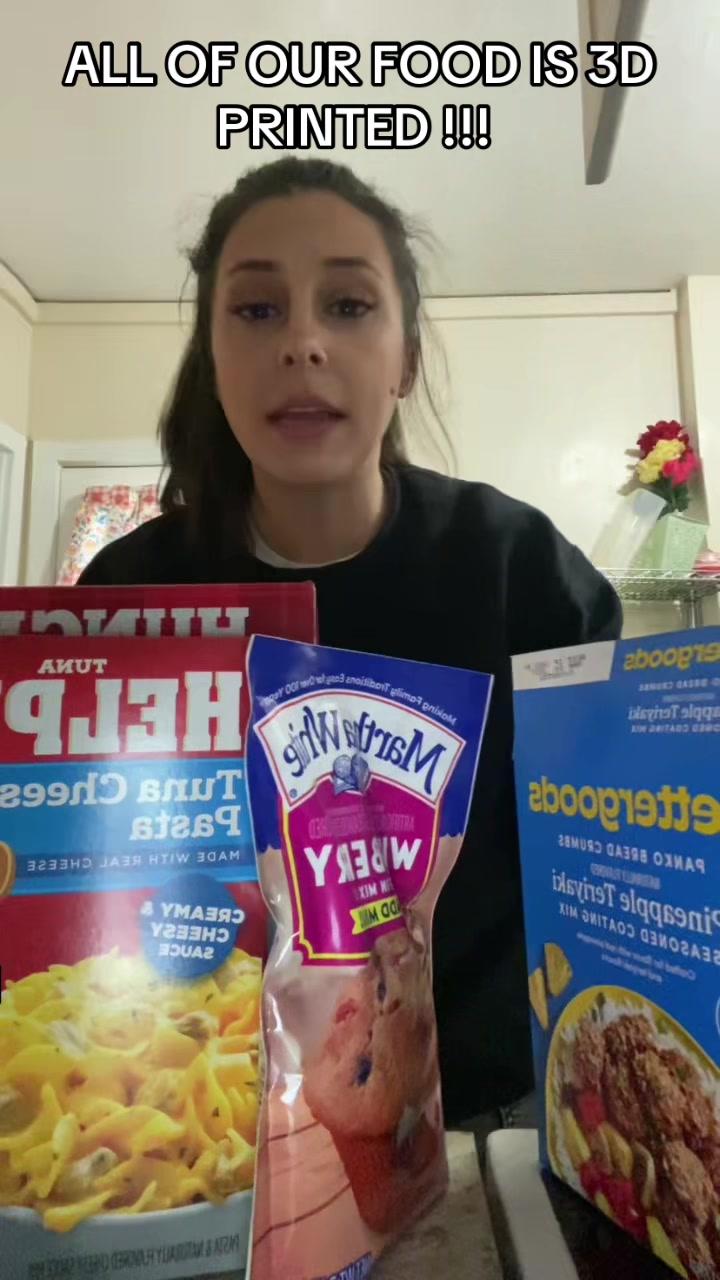
(Image Source: Lead Stories screenshot from tiktok.com/@hethskiii/video/7578991818088500494.)
Text captioning on the video reads:
All of our food is 3D printed!!!
What she is saying in the video has nothing at all to do with 3D printing, although when she gets to the grits she calls them "3D". She is showing an assortment of foods she has found in her home which have bioengineered ingredients. She starts off:
Y'all, I've been going crazy because the bioengineer food shit! This has got bioengineered, this, the tuna (inaudible) almost every week. Hungry Jack -- bioengineered. This shit is like make chicken -- bioengineered. Mother F---- grits B---- it says bioengineered food! Not an ingredient! -- so this whole thing is 3D! Of course anything Campbells. B---- the El Paso enchilada sauce is bioengineered. This! Ritz crackers! I ate this whole box!
Another video (archived here) posted by @hethskiii on Dec. 4, 2025 is captioned:
I just make videos. I don't look up or research shit! 😆🤣😆 #entertainment #funny #fyp
In this video @hethskiii says:
Look now, y'all don't be taking health advice from me. OK? You follow me for entertainment only. Alright? I am not the one to get advice from. B---- I am not healthy. I smoke blunts for breakfast.
A Feb. 1, 2022 article (archived here) from the Center for Science in the Public Interest is titled, "Understanding the new bioengineered disclosure". The article explains:
In July 2016, President Obama signed the National Bioengineered Food Disclosure Law (NBFDL), requiring food manufacturers to disclose the presence of bioengineered foods and ingredients. A "bioengineered" plant or animal has had a new gene inserted into it to give it a useful trait. GMO papayas, for example, have been given a gene that makes them resistant to the ringspot virus. "Bioengineering" is a synonym for the more familiar terms "GMOs," "genetically modified", and "genetically engineered." A bioengineered food or ingredient must contain some of the newly introduced DNA. According to the National Academy of Sciences and the FDA, bioengineered foods are safe to eat and pose no risk to your health.
The article finishes with a list of 13 foods which were on the USDA list in 2022. Currently there are 14 foods on the USDA list (archived here). An insect-resistant bioengineered sugarcane was added to the list in 2023. The list on the USDA website has hyperlinks to .pdf files with more information about each food.
- Alfalfa
- Apple (ArcticTM varieties)
- Canola
- Corn
- Cotton
- Eggplant (BARI Bt Begun varieties)
- Papaya (ringspot virus-resistant varieties)
- Pineapple (pink flesh varieties)
- Potato
- Salmon (AquAdvantage®)
- Soybean
- Squash (summer, coat protein-mediated virus-resistant varieties)
- Sugarbeet
- Sugarcane (Bt insect-resistant varieties)
Chefs and scientists are looking into ways that 3D printing technology can be utilized in food production. 3D-printed food does not necessarily involve bioengineered food ingredients, and conflating the two things is nonsensical. A Feb. 1, 2024 article (archived here) from the American Chemical Society is matter of fact about the practical challenges of this culinary medium:
In the past decade, food scientists have been modifying the software and hardware normally used for sculpting plastic and putting it to work on printing concoctions of peanut butter and other ingredients. At the same time, they have been wrestling with how food that flows through the tubes of a 3D printer can be as tasty as the traditional stuff.