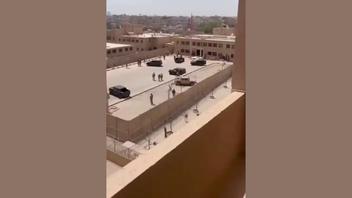
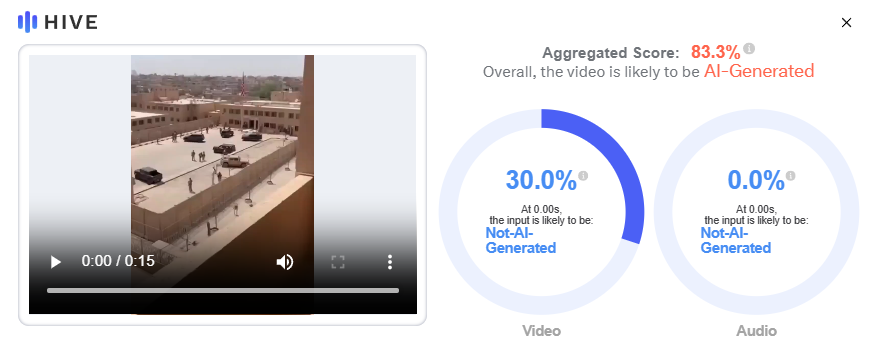
Is this a real video of an airstrike on a U.S. base in Qatar? No, that's not true: An online AI video detection tool determined that the clip is 83.3 percent "likely to be AI-generated." A separate tool identified typical AI "hallucinations," including a distorted U.S. flag, static lighting during the blast, unrealistic smoke and debris interactions, and unusually clear audio that would normally be distorted in a real explosion.
The claim appeared in a post and video (archived here) on X on March 17, 2026. It read:
A 100% successful strike on the U.S. base in Qatar.@grok this is real?
This is what the post looked like on X at the time of writing:
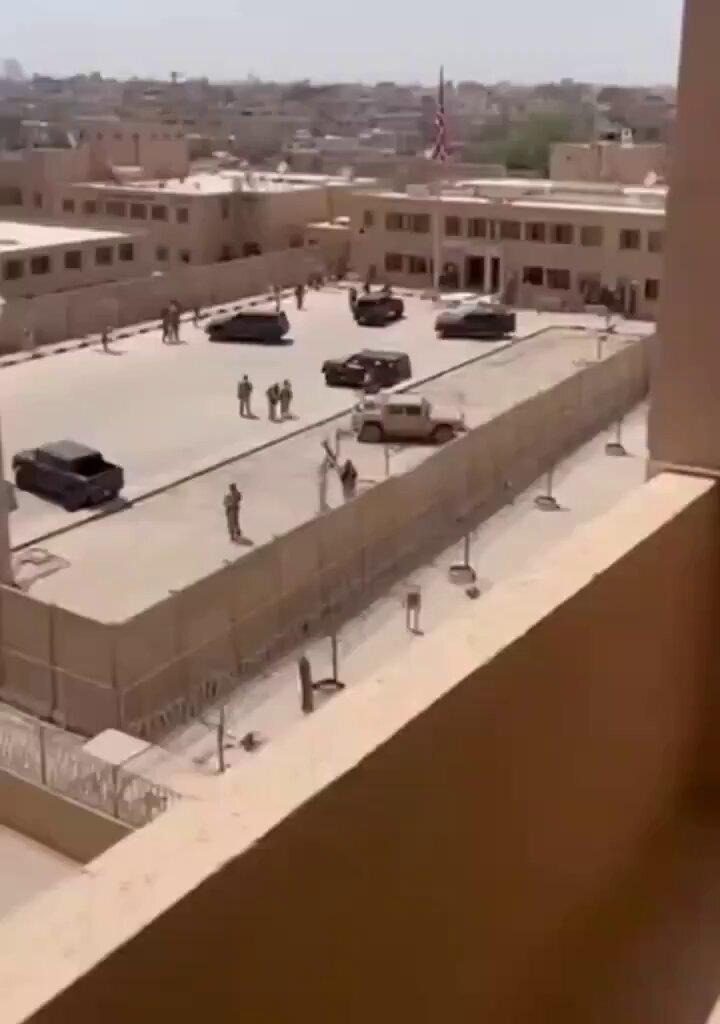
(Image source: post by @Realarafi on X.com.)
You can watch the video here:
A 100% successful strike on the U.S. base in Qatar.@grok this is real? pic.twitter.com/oMzY3fp5Fb
-- Ayatollah Alireza Arafi (@Realarafi) March 17, 2026
Conflict in the Middle East
The United States and Israel launched an ongoing military operation against Iran on Feb. 28, 2026, that killed its supreme leader, Ayatollah Ali Khamenei, in an airstrike on his compound in Tehran. Iran has responded with drone and missile strikes against the U.S. and allied targets across the Middle East, including in Qatar.
Iran's Press TV reported (archived here) on March 17, 2026, that the Islamic Revolutionary Guard Corps "conducted a successful strike against Al Udeid Air Base in Qatar." If that had happened, it would have been major news. Lead Stories searched Google News (archived here) and Yahoo! News (archived here) and did not find any matching reports for March 2026 other than in Iranian media.
Video analysis
Lead Stories ran the video through Gemini (archived here), Google's AI assistant. It reached these conclusions:
Based on an analysis of the video and its origins, there is strong evidence that this video is AI-generated and does not depict a real event.
While the
synth_idtool did not find a watermark from Google's specific AI tools, fact-checking organizations and digital forensics experts have analyzed this specific clip and identified it as a fabrication.Key Evidence:
Visual Inconsistencies: Close analysis reveals several 'hallucinations' common in AI-generated video. For example, the U.S. flag in the background has distorted edges and does not move naturally. Additionally, the lighting on nearby objects (like the balcony and the equipment) remains static during the blast, whereas a real explosion of that scale would cause significant changes in light and shadow.
Physical Anomalies: The smoke and debris do not interact realistically with the vehicles or the building's architecture. The 'blending' of colors between the balcony and the rising smoke is a typical sign of digital manipulation.
Unnatural Audio: Experts have noted that the audio is unusually clear and 'crisp' for a recording made from that distance during a massive explosion, which would typically cause microphone clipping or significant distortion.
Source Verification: This video circulated on social media in early March 2026 with claims that it showed a missile strike on a U.S. base in Qatar. Fact-checkers (such as Misbar) investigated these claims and confirmed the footage was digitally created using AI tools.
A second tool, Hive Moderation AI-Generated Content Detection, concluded the video was "likely to be AI-Generated" with an aggregated score of 83.3 percent. The higher the score, the greater the AI content:
(Image source: Hive Moderation.)