Have you seen viral posts showing a map graphic with information about tremors felt all around a state? Lead Stories has spotted a number of such posts recently and found that many of them were created using artificial intelligence. The maps do not show real seismic data or official emergency preparedness recommendations, just alarmist clickbait.
This article is part of a series of stories examining various types of what is commonly called "AI-slop": in this case Facebook posts, but often short, vertical videos generated with AI tools with the aim of going viral, often by exploiting the emotions or curiosity of the viewer with made-up content.
What these fake 'Earthquake Report' posts look like
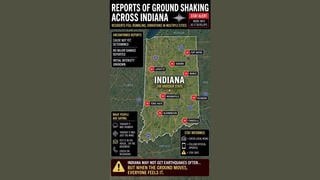
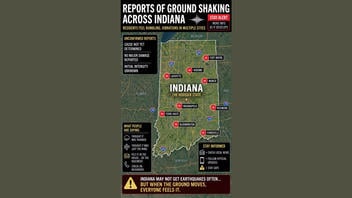
The AI-generated graphic shows a detailed satellite map with the main roads and the cities named in the fake report highlighted. The captioning in the graphic has bullet point lists and an emphasis on staying safe and alert. In some cases the shape of the state map is distorted, apparently to make the state fit better in the vertical format of the post.
Some examples
One example is a post (archived here) by the Life In Indiana Facebook page on Sept. 15, 2026:
A post from a page called Life In Kentucky (archived here) has an AI content label and the map of the state is squished east to west:
The map for the post from Life in Oklahoma (archived here) is also squished:
A final squished example is in a post from Massachusetts Life (archived here):
Keywords
The captions of the posts follow a copy-and-paste formula, swapping out the names of the states and including lists of specific cities. Some passages sound official; others are narrative in tone. Here are some examples found in captions for an assortment of posts:
- Reports of ground shaking across [STATE]
- Strange rumbling and sudden vibrations are being reported across [STATE]
- Something moved ... and [STATE] felt it.
- "People say it happened suddenly ... a deep rolling vibration ... windows rattling ... floors lightly shaking ... just enough for everybody to stop mid-conversation like: 'wait ... did y'all feel that too??'"
- Some blamed thunder. Some blamed construction.
- not one county ... not one town ... but random pockets across the state all feeling the same weird movement
- Officials are still investigating the cause ... but one thing's for sure: something definitely made itself known today.
- And in [STATE] ... when the ground shakes even a little bit -- EVERYBODY notices.
- Officials have not confirmed a statewide event, and there are no confirmed reports of major damage
- Stay alert, [STATE].
Examples of hashtags used in the posts:
#GroundShake #GroundShaking #Earthquake #StrangeRumbling #StayAlert #BreakingNews #KentuckyNews #OhioNews #OnlyInIndiana #IndianaLife #WyomingLife #WyomingStrong #CornfieldEnergy #MidwestLife #IndianaWeather #WyomingWeather #KentuckyWeather #OhioWeather #Indiana #HoosierState #Wyoming #Kentucky #BluegrassState #Ohio #BuckeyeState
How to tell they are false
A review of the United States Geological Survey (USGS) Earthquake Map (archived here), set to view all the recorded earthquakes in the past month (pictured below), shows that at the time of writing, Sept. 16, 2026, for example, there have been no earthquakes at all for the past month in Indiana. One 2.2 magnitude earthquake was recorded in Marshfield, Ohio on Aug. 31, 2026, and one 2.5 magnitude earthquake was recorded in Massac, Kentucky, on Aug. 30, 2026.
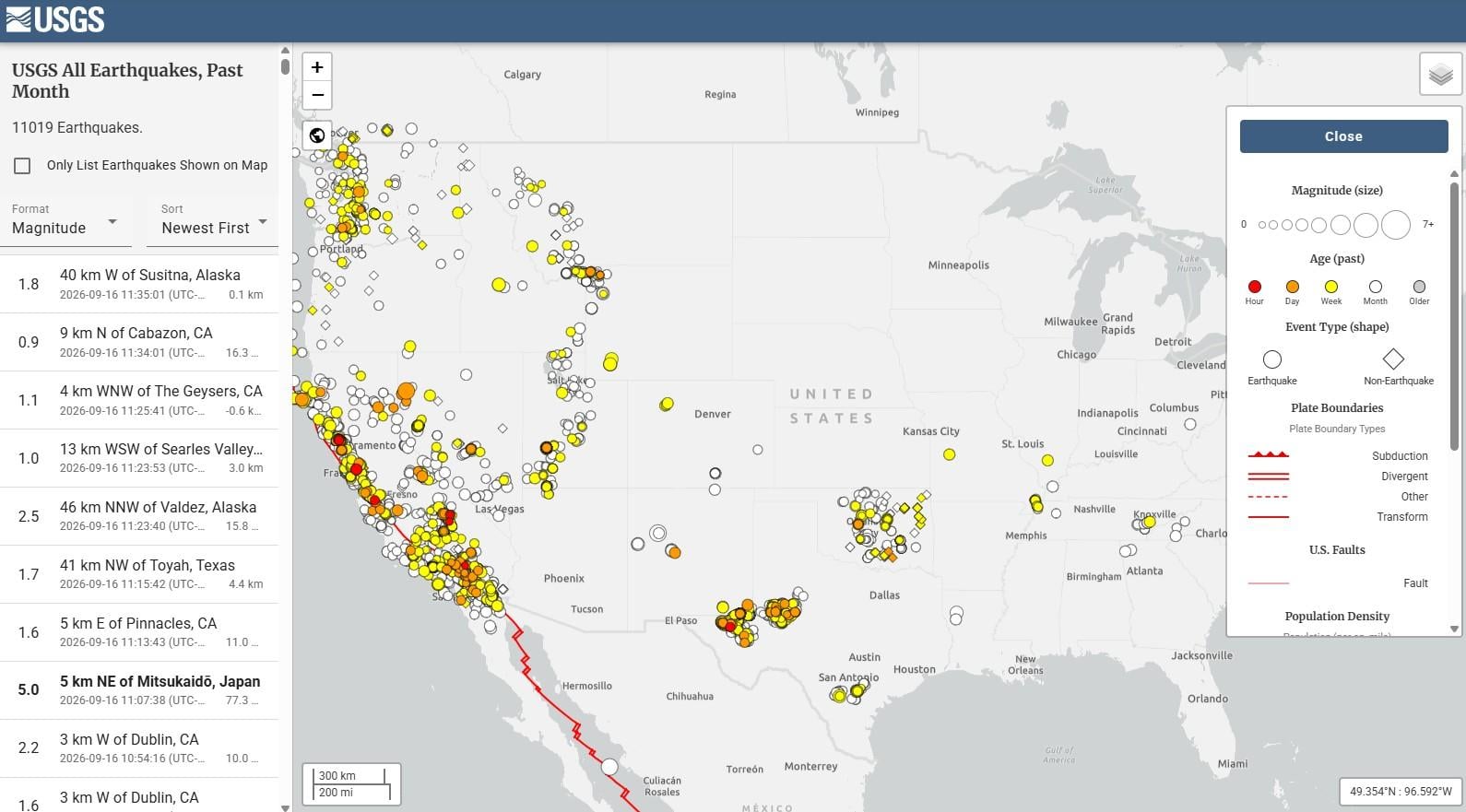
(Image source: earthquake.usgs.gov.)
The USGS page on "Felt Earthquakes" (archived here) explains what people may experience from various depth and magnitude earthquakes, and encourages people to make a citizen science report on their "Did You Feel It?" page (archived here). It reads:
Residents of Hawaii are accustomed to feeling earthquake shaking. The magnitude, location, and depth of an earthquake, and overlying soil conditions determine how widely and strongly any particular event can be felt. Typically, people report feeling earthquakes larger than about magnitude 3.0.
Posts like these are designed to catch the attention of people who live in a certain region and prompt them to comment and share. They come from a large network of pages and groups that originate in Bangladesh. A search on Facebook for recent posts and the phrase "strange rumbling across state" produced many results that had similarities (examples pictured in the GIF below), both in the design of the AI-generated maps, the caption with each post and the Facebook pages making the posts -- with names like Life in Oklahoma (archived here), Massachusetts Life (archived here), Indiana Life (archived here), Kentucky Life (archived here) and North Carolina Life (archived here).
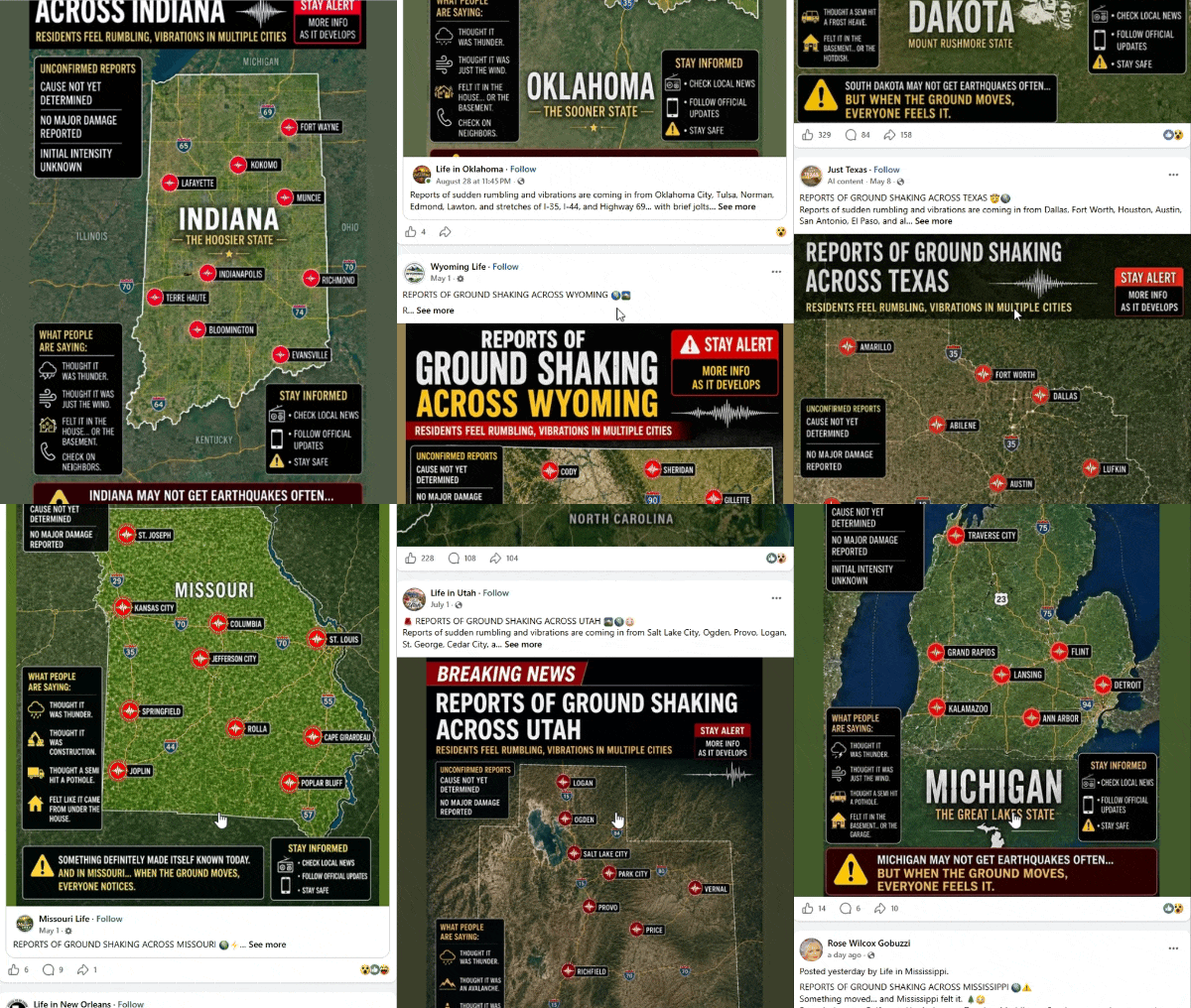
(Image source: search results on Facebook.)
Some of the posts date back to May 2026, while others are from late August and early September. Additional posts name the states: Alaska, Arizona, Arkansas, California, Colorado, Connecticut, Florida, Georgia, Hawaii, Idaho, Louisiana, Michigan, Missouri, Mississippi, Montana, Nebraska, New Jersey, New Mexico, New York, Ohio, Oregon, South Dakota, Texas, Utah, Vermont, Virginia, West Virginia and Wyoming. In some cases there is more than one state-specific Facebook page targeting a given state. The "Page transparency report" of the Facebook pages does not always show the countries of the page managers, but when it is noted, such as with Life in Oklahoma (pictured below), the pages are run from Bangladesh (archived here).
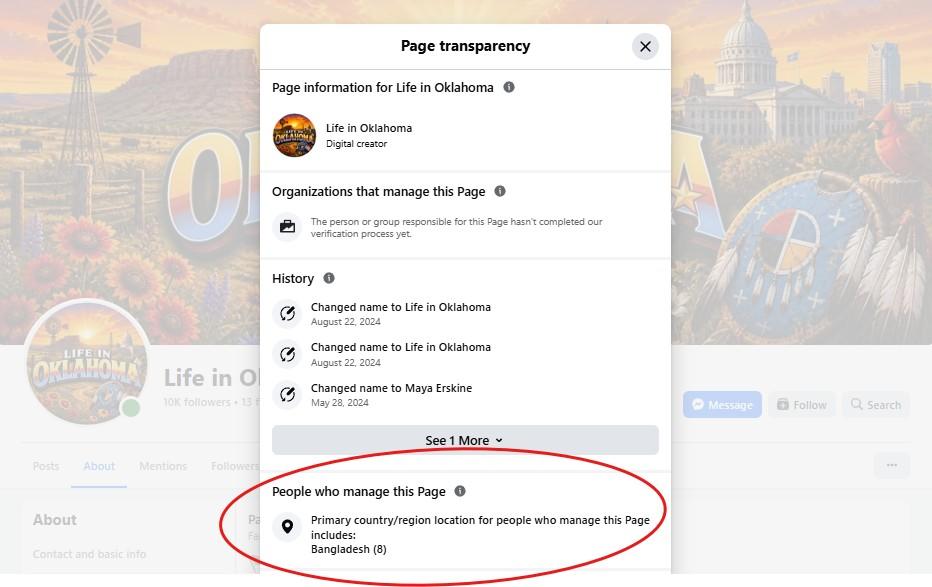
(Image source: Life In Oklahoma on Facebook.)
There are also state-specific Facebook groups where these pages post, such as We Love Texas (archived here), and I grew up in Massachusetts (archived here). The groups are also part of the same spam network. In the I grew up in Massachusetts group, six of the 15 admin accounts appear to belong to the same person who lives in Bangladesh. The We Love Texas group has 96 admins: Most of them are Facebook "fan pages," many with fewer than 10 followers and made to resemble the profile of an American person.
If you see posts like these on social media, here are some things you can try:
First, look for AI-disclaimers added by the platform or the poster. On TikTok they might say "Contains AI-generated media" or "AI-generated" (archived here), on X they read "Made with AI" (archived here) and on Facebook/Instagram they often say "AI info" (archived here). Check the description of the video too: In some cases the creator might have added a note or a hashtag like #AI, #madewithAI or #fiction. Don't forget to check the main page of the account that posted the video either: Maybe there is a disclaimer in the bio. In some cases AI use is really obvious when an account is posting dozens and dozens of variations of the same type of post.
Unsure about a post? Email [email protected] and we will take a look!
These materials were developed in 2026 for the Prebunking at Scale project, with support from the European Fact-Checking Standards Network. If you share this on social media, use #prebunkingatscale.